
In Melbourne’s fast-growing property and design landscape, 3D visualization has become an essential tool for architects, developers, and marketers. Whether it’s bringing a high-rise project to life before construction or creating immersive interior visuals for client approvals, the choice of rendering technique plays a crucial role.
Two of the most talked-about approaches today are photorealistic rendering and neural rendering. But what exactly do these terms mean, and which is better for your Melbourne projects? Let’s break it down.
What is Photorealistic Rendering?
Photorealistic rendering refers to CGI visuals that look almost indistinguishable from real photographs.
- It relies on 3D modelling, lighting, textures, and ray-tracing technology.
- Every detail, from the shine on polished timber floors to the reflection of Melbourne’s skyline in glass facades, is meticulously crafted.
- This method is widely used for architectural visualization, marketing materials, and design approvals.
Example use in Melbourne: Developers in Docklands or Southbank often use photorealistic renders to market luxury apartments before construction, giving buyers confidence in what they’re investing in.
What is Neural Rendering?
Neural rendering is a newer, AI-driven approach. Instead of relying purely on manual modelling and rendering engines, it uses deep learning algorithms to generate or enhance visuals.
- AI systems are trained on vast datasets of real images and can generate lifelike results with less manual effort.
- Neural rendering can create realistic materials, fill missing textures, and even simulate lighting conditions automatically.
- It’s particularly effective for rapid iterations, real-time experiences, and creating immersive virtual environments.
Example use in Melbourne: A design studio might use neural rendering to quickly visualize different interior styles for a client in Carlton or Fitzroy, allowing faster decision-making without waiting hours for traditional render outputs.
Key Differences Between Photorealistic and Neural Rendering
| Aspect | Photorealistic Rendering | Neural Rendering |
|---|---|---|
| Technology | Traditional 3D software + ray tracing | AI & deep learning algorithms |
| Quality | Hyper-realistic, controllable, pixel-perfect | Realistic, but sometimes less predictable |
| Speed | Slower (complex projects take hours/days) | Faster output, real-time possible |
| Flexibility | Full control over every element | Limited control, AI may generate unexpected details |
| Use Cases | Marketing visuals, construction approvals, print ads | Quick design variations, VR/AR experiences, interactive demos |
| Cost Factor | Higher due to manual expertise | Lower for iterations, but still evolving tech |
Which is Best for Melbourne Projects?
The choice depends on your project goals:
- For developers & marketers:
Photorealistic rendering is still the gold standard. Buyers in Melbourne’s competitive property market expect visuals that look identical to reality. When selling high-value apartments in Toorak or luxury townhouses in Brighton, precision and detail matter. - For architects & designers in early stages:
Neural rendering offers speed and flexibility. If you’re pitching concepts or experimenting with layouts in suburbs like St Kilda or Richmond, AI-assisted renders can provide instant visuals without the long rendering times. - For immersive experiences (VR/AR):
Neural rendering is ahead. Real-time interactions for Melbourne exhibitions, real estate showcases, or virtual walkthroughs benefit from AI-driven rendering.
The Hybrid Approach: Best of Both Worlds
Forward-thinking studios in Melbourne are starting to use both methods together:
- Neural rendering for quick client feedback and design tweaks.
- Photorealistic rendering for the final polished marketing visuals.
This hybrid model reduces turnaround times while still delivering the photorealism Melbourne clients demand.
Final Thoughts
Both photorealistic and neural rendering have their place in Melbourne’s design and property ecosystem.
- If you need pixel-perfect, market-ready visuals, photorealistic rendering remains unbeatable.
- If you want speed, experimentation, and immersive experiences, neural rendering is worth exploring.
At 3D Space Design Melbourne, we specialize in photorealistic 3D rendering while actively exploring the potential of neural rendering to support faster project cycles. Whether you’re a developer, architect, or real estate professional, we’ll recommend the right approach based on your goals.
👉 Looking to showcase your next Melbourne project? Get in touch with our team to explore which rendering style works best for you.
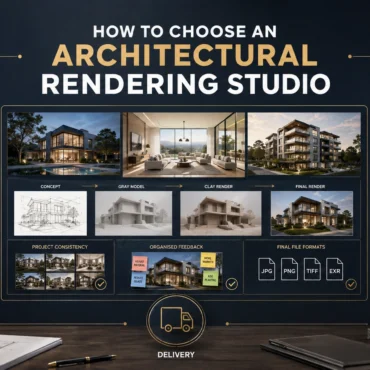
How to Choose an Architectural Rendering Studio
Skip to the answer Home / Blogs / Choosing a rendering studio PORTFOLIO FIT · PROCESS · SCOPE · COMMUNICATION How to Choose an Architectural Rendering Studio in Australia: 10...
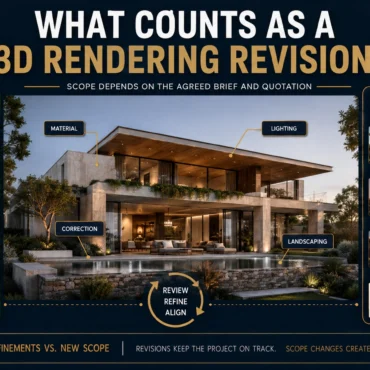
What Counts as a 3D Rendering Revision?
Skip to the answer Home / Blogs / Rendering revisions FEEDBACK ROUNDS · DESIGN CHANGES · CAMERA CONTROL · SCOPE What Counts as a Revision in Architectural Rendering? Feedback, Changes...

Architectural Rendering Quote: What Is Included?
Skip to the answer Home / Blogs / Rendering quote inclusions SCOPE · REVISIONS · DELIVERABLES · CHANGE CONTROL What Is Included in an Architectural Rendering Quote? Scope, Revisions and...
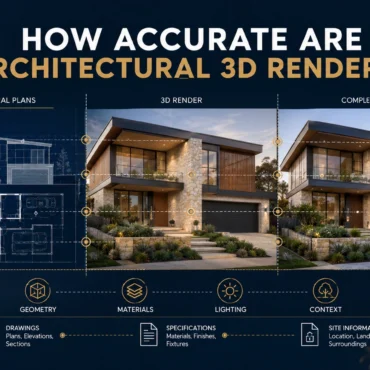
How Accurate Are Architectural 3D Renders?
Skip to the answer Home / Blogs / Render accuracy GEOMETRY · MATERIALS · CAMERAS · ASSUMPTION CONTROL How Accurate Are Architectural 3D Renders? Geometry, Materials and Assumptions Explained A...
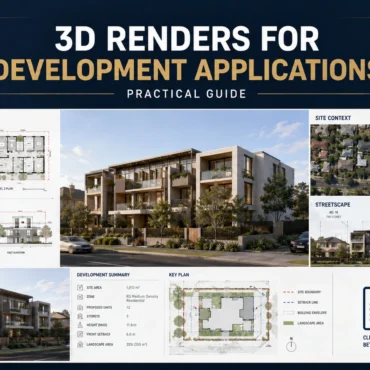
3D Renders for Development Applications | Guide
Skip to the answer Home / Blogs / Development application renders PLANNING COMMUNICATION · DESIGN CONTEXT · STAKEHOLDER REVIEW Can 3D Renders Be Used for Development Applications? An Australian Planning...
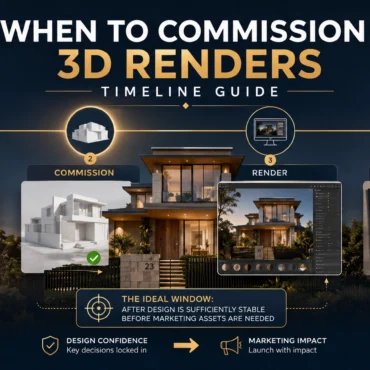
When to Commission 3D Renders | Timeline Guide
Skip to the answer Home / Blogs / Commissioning timeline PROJECT PLANNING · DESIGN READINESS · CAMPAIGN DELIVERY When Should You Commission 3D Renders? A Property Development Timeline A practical...
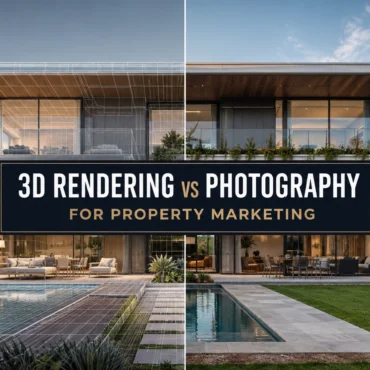
3D Rendering vs Photography: Which Is Better for Property Marketing?
Skip to the answer Home / Blogs / Rendering vs photography PROPERTY MARKETING · CGI · REAL ESTATE PHOTOGRAPHY 3D Rendering vs Photography: Which Is Better for Property Marketing? A...
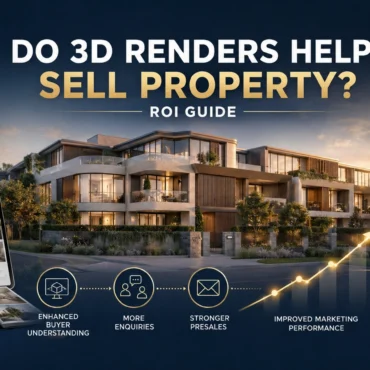
Do 3D Renders Help Sell Property? ROI Guide
Skip to the answer Home / Blogs / 3D rendering ROI PROPERTY MARKETING · ATTRIBUTION · VISUALISATION ROI Do 3D Renders Help Sell Property? A Practical ROI Measurement Guide A...

How to Give Feedback on 3D Renders | Checklist
Skip to the answer Home / Blogs / 3D rendering feedback checklist ARCHITECTURAL VISUALISATION · REVIEW CONTROL · REVISION WORKFLOW How to Give Feedback on 3D Renders: A Revision Checklist...

How to Choose Camera Angles for 3D Rendering
Skip to the answer Home / Blogs / Architectural rendering camera angles ARCHITECTURAL VISUALISATION · CAMERA COMPOSITION · VIEW PLANNING How to Choose Camera Angles for Architectural Rendering: A View-Planning...