
2D vs 3D Floor Plans vs Virtual Tours: What Actually Helps Homes Sell Faster?
In today’s digital-first property market, buyers in Melbourne, Sydney, Brisbane, Perth and other Australian cities don’t just scroll through photos. They zoom into floor plans, explore 3D layouts and click through immersive virtual tours before deciding whether a home is worth visiting. The question is: which of these actually helps your listing stand out and moves serious buyers to enquire?
Why Floor Plans & Virtual Tours Matter So Much in Australian Listings
Most buyers now shortlist properties online before they ever set foot at an open inspection. They compare layout, light, storage and flow from their phone — especially in dense markets like inner Melbourne, Sydney’s north shore, Brisbane CBD and Perth’s growing suburbs.
A listing with only photos forces buyers to guess how rooms connect. A listing with clear floor plans and virtual tours lets them instantly understand:
- Where key areas like kitchen, living and bedrooms sit in relation to each other
- Whether the home suits their lifestyle (kids, pets, work-from-home, multi-generational living)
- How furniture might fit — crucial for apartments and compact homes
- Whether it’s worth booking a physical inspection at all
2D Floor Plans: The Essential Baseline for Every Listing
A 2D floor plan is the classic top-down drawing of a property: walls, doors, windows and room labels. It may show basic measurements and sometimes simple furniture icons.
For most buyers searching for floor plans for house listings in Australia, the 2D plan is still the first reference point. It answers simple but critical questions:
- Is the main bedroom at the front or back of the home?
- Is the living area open plan or separated?
- What is the relationship between indoor and outdoor spaces?
- Is there a practical flow from garage or entry through to kitchen and living?
Strengths of 2D Floor Plans
- Simple and universally understood by buyers, agents and valuers
- Ideal for quick comparisons between multiple properties in an area
- Easy to print in brochures or use at display suites and auctions
- Perfect for real estate portals that require a clean, lightweight plan image
Limitations of 2D Floor Plans
- Many buyers struggle to visualise ceiling heights, volume and natural light
- It’s harder to imagine how real furniture will feel in each room
- Renovation potential isn’t always obvious from a flat plan
- Properties can feel cold or technical rather than inviting
In short, 2D plans are non-negotiable — but they rarely create the emotional connection that moves a buyer from curiosity to “this could be our home”.
3D Floor Plans: Turning Layout into a Lifestyle Story
A 3D floor plan takes the same layout and renders it in perspective, with walls, finishes, furniture, rugs, plants and styling. It’s essentially a dollhouse view of the home.
For buyers in design-conscious markets like Melbourne’s inner suburbs or Sydney’s eastern beaches, a well-styled 3D floor plan does three powerful things:
- Makes the property feel immediately liveable and welcoming
- Helps buyers understand scale — how a real sofa, dining table or bed fits
- Shows how the layout supports daily life, entertaining, kids and pets

Why 3D Floor Plans Often Convert Better
Compared with a flat drawing, a 3D plan acts like a mini interior-visualisation. Buyers can see themselves in the space, not just read room labels.
- It highlights focal points like kitchen islands, feature windows and alfresco areas
- Compact apartments feel more generous when styled intelligently in 3D
- Oddly shaped rooms suddenly make sense when furniture is placed correctly
- Investors can visualise likely rental appeal in competitive urban markets
Where 3D Floor Plans Shine in Australia
3D floor plans are especially effective for:
- Off-the-plan apartments and townhouses in Melbourne, Sydney, Brisbane and Perth
- Renovated period homes where buyers want to see how old and new areas connect
- Upsizer family homes in growth corridors where space and storage are key selling points
- High-end properties that benefit from showing premium finishes and styling
If you want a layout that feels both clear and aspirational, a 3D floor plan created by a specialist floor layout designer or architectural visualisation studio is often the sweet spot between clarity and emotion.
Virtual Tours: Letting Buyers “Walk Through” from Anywhere
A virtual tour lets buyers move through a property online as if they’re walking from room to room. This can be:
- A 360° tour — series of linked panoramic viewpoints (click to move between rooms)
- A 3D walkthrough — more advanced, often including a dollhouse view and smooth navigation
Key Benefits of Virtual Tours for Australian Listings
- Remote access: Interstate and overseas buyers can inspect without boarding a plane
- Serious, better-informed enquiries: By the time they book a physical inspection, they already understand the layout
- More time spent on your listing: Buyers naturally spend longer engaged with an interactive tour than static photos
- Clearer expectations: Fewer surprises at open homes, because buyers have already explored the space virtually
In suburbs across Australia, virtual tours have moved from “nice to have” to “standard” for many agents — particularly for apartments, prestige homes and properties likely to attract interstate or international interest.
Where Virtual Tours Have the Biggest Impact
Virtual tours work especially well for:
- Inner-city apartments in Melbourne, Sydney and Brisbane where buyers compare dozens of listings from their phone
- Regional or coastal homes attracting city-based tree-changers and sea-changers
- Holiday and investment properties where buyers may not be able to attend opens
- New developments with display suites that can’t show every floor plan variation
2D vs 3D Floor Plans vs Virtual Tours: Side-by-Side Comparison
| Format | Best At | Ideal Use in Australian Cities |
|---|---|---|
|
2D Floor Plan
Essential
Static image
|
|
|
|
3D Floor Plan
Emotional
Styled
|
|
|
|
Virtual Tour
Interactive
Immersive
|
|
|
Choosing the Right Mix for Your Property
1. Inner-City Apartment in Melbourne or Sydney
Buyers here are time-poor and comparison-shopping. Your listing is likely appearing alongside dozens of similar apartments.
- Must-have: 2D floor plan (clear, labelled, easy to read on mobile)
- Strong advantage: 3D floor plan styled to match the target demographic
- Highly recommended: Virtual tour so buyers can inspect from work or interstate
2. Family Home in Suburban Brisbane, Perth or Adelaide
Families care deeply about bedrooms, yard access, storage and separation of zones.
- Must-have: 2D floor plan clearly showing bedroom zones and outdoor areas
- Powerful add-on: 3D floor plan that showcases kids’ rooms, alfresco and living hub
- Helpful: Virtual tour for busy parents and relocating families
3. Off-the-Plan or Newly Renovated Project
When there’s nothing built yet, buyers heavily rely on visualisation to make decisions.
- Essential: 2D floor plan for each dwelling type or configuration
- Highly effective: 3D floor plans that match the intended styling and finishes
- Highly engaging: Virtual tours or 3D walkthroughs of hero layouts
How to Brief a Floor Plan & Virtual Tour Specialist
Whether you work with an architectural renderer, a floor layout designer or a specialist visualisation studio, a clear brief leads to more effective 2D and 3D assets.
- Define your primary buyer. First-home buyers, downsizers, upsizers, investors, luxury buyers — each group looks for different things.
- Share accurate architectural plans. Provide the latest drawings, including levels, outdoor areas and any recent changes.
- Highlight key selling points. Northern light, views, flexible study niches, butler’s pantry, extra storage, oversized balcony, double garage and so on.
- Clarify styling direction for 3D floor plans. Coastal, contemporary, minimal, family-friendly, industrial, etc. Styling should match local expectations in your suburb or city.
- Specify portal formats. Confirm required sizes and formats for major portals and your own website so assets can be exported correctly.
With the right brief, a specialist can turn even a basic drawing into a highly effective rendering floor plan and virtual tour that supports every other part of your campaign.
FAQs About Floor Plans & Virtual Tours in Australia
They work best together. A 2D floor plan is the clearest way to show layout at a glance. A 3D floor plan builds on that by showing how the space feels when furnished. For most homes in cities like Melbourne and Sydney, 2D is the baseline, while 3D is the upgrade that creates emotional impact.
Yes. Many buyers and agents quickly refer to the 2D plan to understand proportions, entry points and room relationships. Virtual tours are fantastic for immersion, but 2D plans remain the simplest reference tool in portals, brochures and emails.
Virtual tours have become part of normal buyer behaviour, especially for apartments, high-value homes and properties drawing interest from outside the local area. They are particularly useful for interstate and overseas buyers comparing multiple options before booking an in-person inspection.
Smaller or older properties can benefit significantly from clear visual communication. A clean 2D plan and a thoughtfully styled 3D floor plan can help buyers see potential and understand how to use the space, instead of focusing purely on existing finishes.
Next step: When you prepare your next listing in Melbourne, Sydney, Brisbane, Perth, Adelaide or any other Australian city, treat 2D plans, 3D floor plans and virtual tours as a complete visual toolkit. The right mix will make your listing easier to understand, more memorable and far more compelling to serious buyers.
Suggested focus keywords: floor plans for house · 3D floor plan · floor layout designer · rendering floor plan · virtual tour for real estate Australia
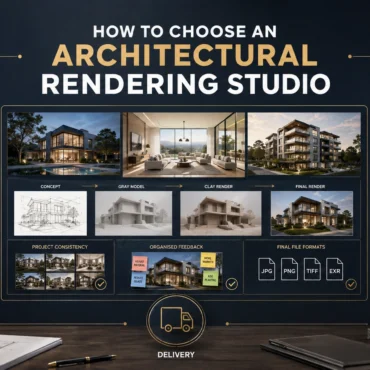
How to Choose an Architectural Rendering Studio
Skip to the answer Home / Blogs / Choosing a rendering studio PORTFOLIO FIT · PROCESS · SCOPE · COMMUNICATION How to Choose an Architectural Rendering Studio in Australia: 10...
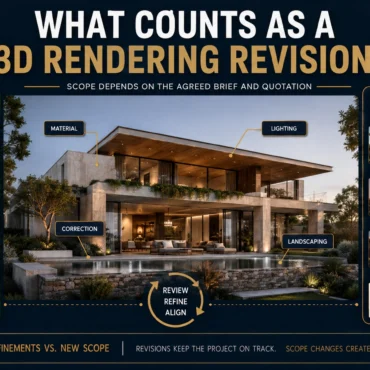
What Counts as a 3D Rendering Revision?
Skip to the answer Home / Blogs / Rendering revisions FEEDBACK ROUNDS · DESIGN CHANGES · CAMERA CONTROL · SCOPE What Counts as a Revision in Architectural Rendering? Feedback, Changes...
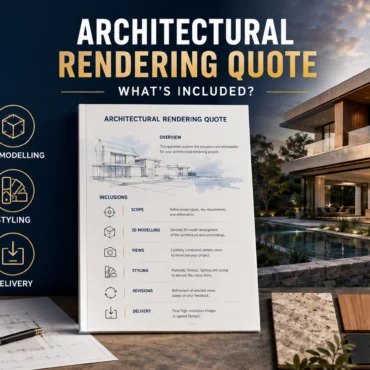
Architectural Rendering Quote: What Is Included?
Skip to the answer Home / Blogs / Rendering quote inclusions SCOPE · REVISIONS · DELIVERABLES · CHANGE CONTROL What Is Included in an Architectural Rendering Quote? Scope, Revisions and...
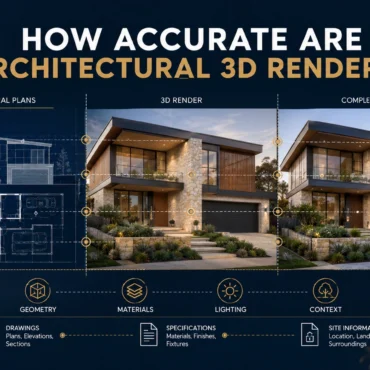
How Accurate Are Architectural 3D Renders?
Skip to the answer Home / Blogs / Render accuracy GEOMETRY · MATERIALS · CAMERAS · ASSUMPTION CONTROL How Accurate Are Architectural 3D Renders? Geometry, Materials and Assumptions Explained A...
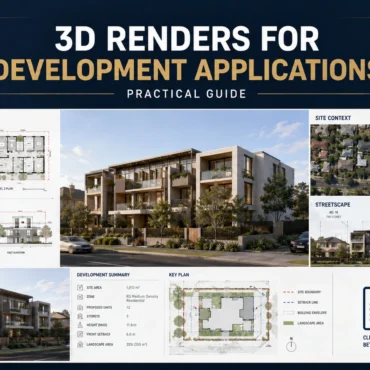
3D Renders for Development Applications | Guide
Skip to the answer Home / Blogs / Development application renders PLANNING COMMUNICATION · DESIGN CONTEXT · STAKEHOLDER REVIEW Can 3D Renders Be Used for Development Applications? An Australian Planning...
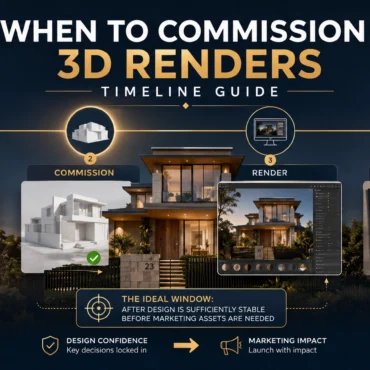
When to Commission 3D Renders | Timeline Guide
Skip to the answer Home / Blogs / Commissioning timeline PROJECT PLANNING · DESIGN READINESS · CAMPAIGN DELIVERY When Should You Commission 3D Renders? A Property Development Timeline A practical...
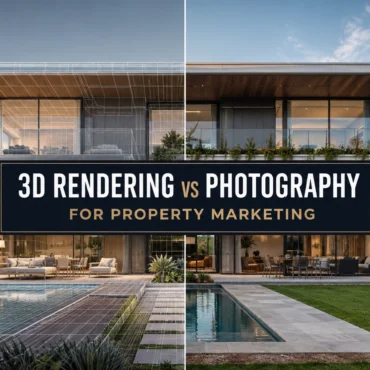
3D Rendering vs Photography: Which Is Better for Property Marketing?
Skip to the answer Home / Blogs / Rendering vs photography PROPERTY MARKETING · CGI · REAL ESTATE PHOTOGRAPHY 3D Rendering vs Photography: Which Is Better for Property Marketing? A...
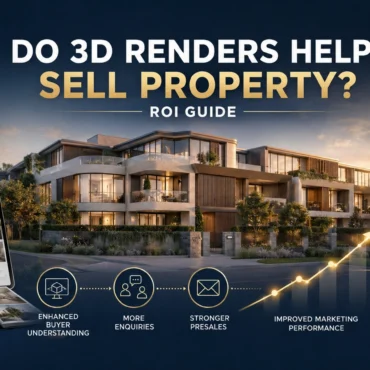
Do 3D Renders Help Sell Property? ROI Guide
Skip to the answer Home / Blogs / 3D rendering ROI PROPERTY MARKETING · ATTRIBUTION · VISUALISATION ROI Do 3D Renders Help Sell Property? A Practical ROI Measurement Guide A...

How to Give Feedback on 3D Renders | Checklist
Skip to the answer Home / Blogs / 3D rendering feedback checklist ARCHITECTURAL VISUALISATION · REVIEW CONTROL · REVISION WORKFLOW How to Give Feedback on 3D Renders: A Revision Checklist...

How to Choose Camera Angles for 3D Rendering
Skip to the answer Home / Blogs / Architectural rendering camera angles ARCHITECTURAL VISUALISATION · CAMERA COMPOSITION · VIEW PLANNING How to Choose Camera Angles for Architectural Rendering: A View-Planning...