
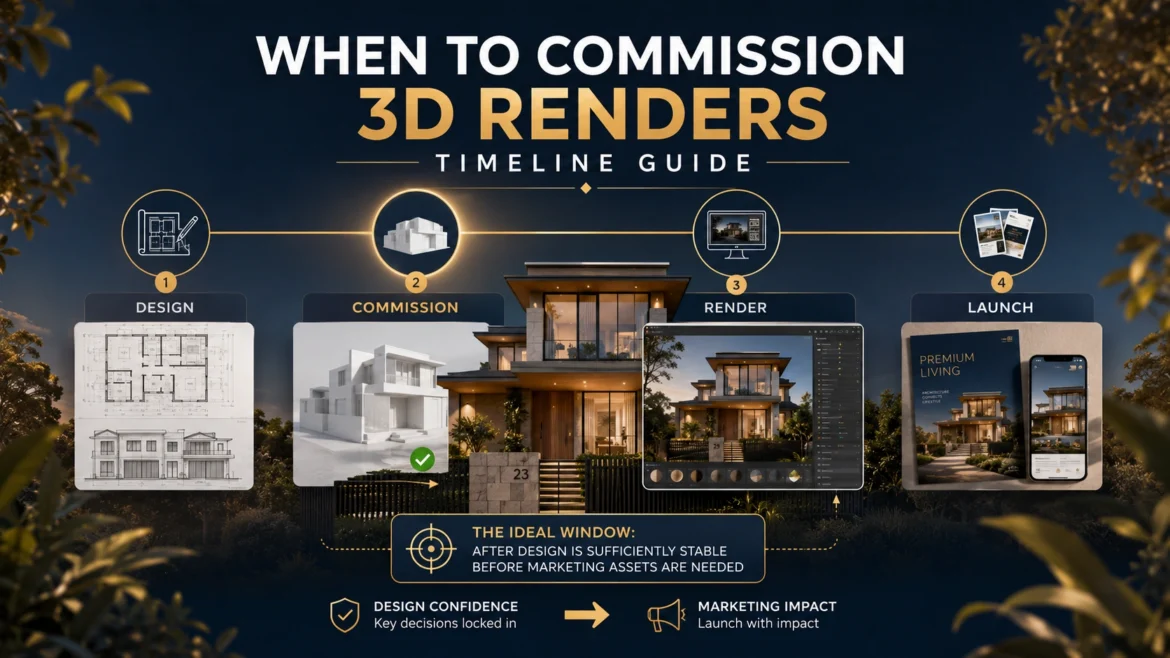
When to Commission 3D Renders | Timeline Guide
PROJECT PLANNING · DESIGN READINESS · CAMPAIGN DELIVERY
When Should You Commission 3D Renders? A Property Development Timeline
A practical guide to starting architectural visualisation early enough for approvals and property marketing—but late enough that geometry, materials, landscape and review responsibilities are sufficiently resolved.
- Design readiness
- Campaign milestones
- Review buffers
- Delivery checklist
Quick answer
What is the right time to commission 3D renders?
Begin scoping before the campaign or approval deadline is fixed, but start marketing-quality production only when the core geometry, intended cameras, principal materials, landscape direction and decision owners are sufficiently stable.
Starting too early creates avoidable remodelling and repeated approvals. Starting too late compresses camera review, material refinement, revisions, final crops and quality control. The practical approach is to work backwards from the required delivery date, set a documented design-information cutoff and separate early internal studies from final campaign assets. Complex developments may need phased releases rather than one all-or-nothing render package.
Build a reverse production planProject teams we have supported
Who we have worked with







In this guide
Work backwards from the real deadline
Ten factors that determine when rendering should begin
The correct start date is a balance between design certainty and campaign lead time. Resolve these factors before committing final production dates.
-
01
Required delivery date
Start with the date final assets must enter websites, portals, print, signage, presentations or advertising—not merely the public campaign launch.
-
02
Approval milestones
Investor meetings, planning submissions, design reviews and sales approvals may require earlier studies before marketing-quality imagery begins.
-
03
Geometry maturity
Major changes to massing, openings, levels, facade systems or interiors can trigger substantial remodelling if production starts before a usable design cutoff.
-
04
Model and drawing readiness
Confirm which model can be supplied, its accuracy and what drawings must fill gaps. File cleanup and reconstruction should be visible in the schedule.
-
05
Material decisions
Principal finishes, colours, glazing, joinery and fixtures should be specified or clearly marked as assumptions before detailed material work is approved.
-
06
Landscape and context
Planting, levels, boundaries, neighbouring structures, streetscape and views can materially change composition and should not arrive only at final review.
-
07
View and camera plan
Agree what each image must communicate and approve cameras before intensive material, lighting, entourage and post-production work.
-
08
Feedback availability
Named reviewers need protected response windows. Delayed or fragmented feedback can extend the schedule even when production work is on time.
-
09
Final output list
Landscape, square, portrait, mobile, signage and print requirements affect camera framing, render resolution, adaptations and quality-control time.
-
10
Change contingency
Preserve schedule space for documented revisions, file issues and final delivery checks. Do not treat every available day as active rendering time.
Stage-by-stage decision guide
What type of rendering fits each development stage?
Not every stage needs final marketing imagery. Match the visual output to the certainty of the available information and the decision it must support.
| Development stage | Useful visual output | Minimum useful inputs | Main timing risk |
|---|---|---|---|
| Concept | Simple massing, option or atmosphere studies for internal decisions | Basic geometry, site intent, reference direction and named question | Treating exploratory imagery as approved marketing content |
| Schematic design | Camera and design-communication studies for stakeholder review | Coordinated plans, elevations, model and major material direction | Large geometry changes after cameras are approved |
| Design development | Refined views with credible facade, interiors, landscape and context | Current geometry, principal finishes, levels, context and landscape | Unresolved selections hidden inside polished imagery |
| Pre-marketing | Campaign-quality heroes, supporting views and planned channel crops | Approved cameras, stable design, materials, lighting and output list | Print, web and signage specifications arriving after final renders |
| Launch and updates | Final adaptations, approved revisions and additional scoped assets | Current project information, campaign learnings and change register | Emergency changes bypassing normal review and quality control |
Confirm final formats early with the property-marketing render specification guide, then use the stage table to decide when a view is ready for marketing-quality refinement.
Three useful commissioning patterns
Choose the production pattern that matches design certainty
The right pattern depends on whether the team needs internal decisions, final campaign assets or a sequence of releases across multiple milestones.
Concept-study scope
Use lower-detail, explicitly internal studies to compare camera, massing, facade or atmosphere before committing final campaign production.
- Named design questions
- Limited finish detail
- Fast option comparison
- Not final marketing art
Marketing-production scope
Start after a documented information cutoff when cameras, geometry, principal materials, context and outputs are sufficiently stable.
- Approved camera list
- Resolved core inputs
- Consolidated feedback
- Final channel adaptations
Phased-release scope
Plan separate view groups for approvals, presales, launch and later stages when one design freeze or delivery date is unrealistic.
- Prioritised hero views
- Stage-specific cutoffs
- Shared visual system
- Controlled change register
Different teams control different inputs
What should each project team resolve before production?
Property developers
Set the campaign milestones, priority audience, view budget, decision owner, design-information cutoff and acceptable assumptions before final production.
Visualisation for architectsArchitects and designers
Provide coordinated geometry, materials, lighting, landscape and context; review design accuracy before marketing teams focus on styling and messaging.
Rendering for property developersBuilders and consultants
Flag constructability, product, level, facade, services and site information that could materially change visible parts of the approved cameras.
Plan final output specificationsMarketing and sales teams
Confirm channel ratios, copy-safe areas, campaign hierarchy, print deadlines, disclosure requirements and who consolidates commercial feedback.
View architectural rendering workWork backwards from delivery
A six-step architectural rendering timeline workflow
- 01
Fix the asset-insertion deadline
Identify when final files must enter web, portals, print, signage and advertising production—not only when the public campaign starts.
- 02
Define views and outputs
Name the communication job, camera type, orientation, resolution and channel adaptations required for every proposed asset.
- 03
Set the information cutoff
Record which model, drawings, materials, landscape, context and lighting decisions will govern production and how later changes are handled.
- 04
Approve cameras early
Review composition, focal length, height, crop resilience and visible design information before detailed materials and post-production.
- 05
Consolidate review rounds
Use one feedback owner to collect design, developer and marketing comments, resolve conflicts and return one prioritised response.
- 06
Reserve final-delivery time
Protect time for approved revisions, artefact checks, colour review, final dimensions, file naming and transfer into campaign production.
Render-start checklist
What should be ready before marketing production begins?
Give the studio enough coordinated information to build the approved views without hiding unresolved decisions inside polished imagery.
See the project-file checklist- Final-asset deadline, campaign milestones and channel schedule
- Current coordinated model, drawings and visible design changes
- Principal materials, landscape, lighting and context information
- Approved view list and named communication job for each image
- Landscape, square, portrait, mobile, print and signage outputs
- Consolidated feedback owner, approver and change-control rule
Completed architectural visualisation work
Different views become ready at different project stages.
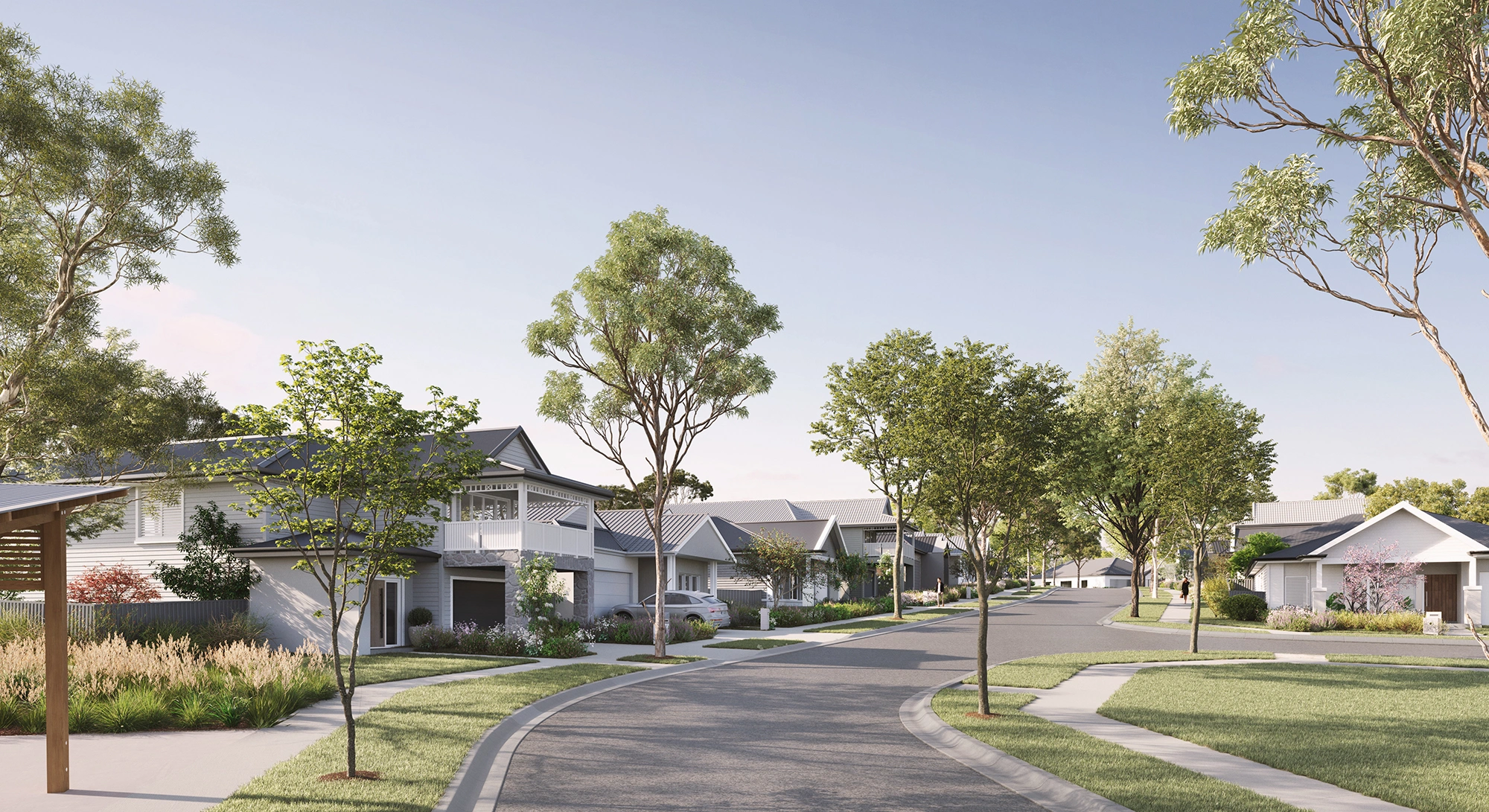
An exterior may require stable facade, levels, planting and site context; an interior needs resolved layout, joinery, materials, lighting and furniture direction; a streetscape adds broader landscape and development information. A phased schedule can release ready views without forcing every asset through an artificial single cutoff. Select any image to enlarge it.

Completed project · Wollert, Victoria
936 Kendon Drive exterior rendering
This completed exterior rendering depends on coordinated building form, facade rhythm, material contrast, glazing, planting, levels and street relationship. Starting the image before those visible inputs were sufficiently stable would increase rework; starting only at campaign handover would remove the time needed for camera approval, refinement and consolidated review.
- Start trigger
- Core exterior geometry, facade intent, levels, landscape direction and project context are usable.
- Early approval
- The camera is reviewed before detailed material, planting, entourage and final image treatment.
- Change control
- Later project information is assessed against the approved view and agreed production scope.
- Timing lesson
- Commission early enough to protect review quality, but after the image’s major visible inputs have identifiable owners.
Protect the production window
Six timing mistakes that delay architectural renders
Starting before geometry stabilises
Major changes to openings, facade, levels or layout after camera approval create avoidable remodelling and repeated composition work.
Waiting for an impossible “final” design
Campaign teams can lose necessary lead time when every minor product and styling decision is treated as a reason not to begin coordination.
Leaving cameras until late
Material and lighting detail may be built for a view that is later rejected, tightly cropped or unable to support required channel formats.
Using too many feedback channels
Separate emails, markups, calls and stakeholder comments create conflicts, omissions and repeated review rather than faster approval.
Adding output formats at delivery
Late requests for portraits, signage, print or text-safe space can require new framing, higher-resolution output or extensive adaptation.
Removing the final QA buffer
A compressed handover leaves less time to catch artefacts, incorrect files, crop failures, colour issues and unresolved project changes.
A reliable programme separates studio production time from client review time, design-team response time and downstream campaign insertion. Delays in any one stream affect the final delivery date.
Frequently asked questions
Architectural rendering timeline FAQs
Short answers for developers, architects and marketing teams scheduling 3D visualisation.
When should property developers commission 3D renders?
Begin scoping before the campaign schedule is locked, then start marketing-quality production when core geometry, intended cameras, principal materials, landscape direction and decision owners are sufficiently stable.
How early should discussions with the rendering studio begin?
Start discussions while campaign, approval or presentation milestones are being planned. Early coordination can identify missing files, unrealistic deadlines, view requirements and output formats before they become production blockers.
Can render production begin before the design is final?
Yes, if the purpose, current information and assumptions are documented. Use early studies for internal decisions, and avoid treating unresolved concept imagery as final marketing content.
What should be resolved before marketing-quality renders begin?
Resolve or document the current geometry, view list, principal materials, landscape and context, lighting direction, campaign outputs, approval owner and the rule for handling later design changes.
How long before campaign launch should final renders be ready?
There is no universal buffer. Work backwards from the dates files enter web, print, signage, portals and advertising, then preserve time for approvals, adaptations, quality control and downstream campaign production.
Should cameras be approved before materials and lighting are refined?
Usually yes. Camera approval establishes what is visible, the required level of detail, crop resilience and composition before substantial work is invested in materials, lighting, entourage and post-production.
What happens if the design changes during rendering production?
Assess the change against the documented information cutoff and approved view. Minor scoped updates may fit a revision round; major geometry, camera or design changes can affect cost, sequence and delivery.
What files and decisions help prevent rendering delays?
Provide a coordinated model and drawings, current material and landscape information, context references, approved view purposes, output specifications, campaign deadlines, one feedback owner and a clear change register.
Request a rendering timeline
When must your final images enter campaign production?
Share the project stage, current drawings or model, view requirements, decision owners, campaign channels and asset-insertion deadline. 3D Space Design can define the input cutoff, review stages, final outputs and delivery sequence within a fixed project scope.
- Quote response within 24 hours
- Up to three revision cycles within the agreed scope
- NDA and confidential-project support
- Defined input cutoff, review stages, outputs and assumptions
PROJECT ENQUIRY
Tell us about your project schedule
Include the project type, current stage, required views, campaign channels, asset deadline and available drawing or model files.