
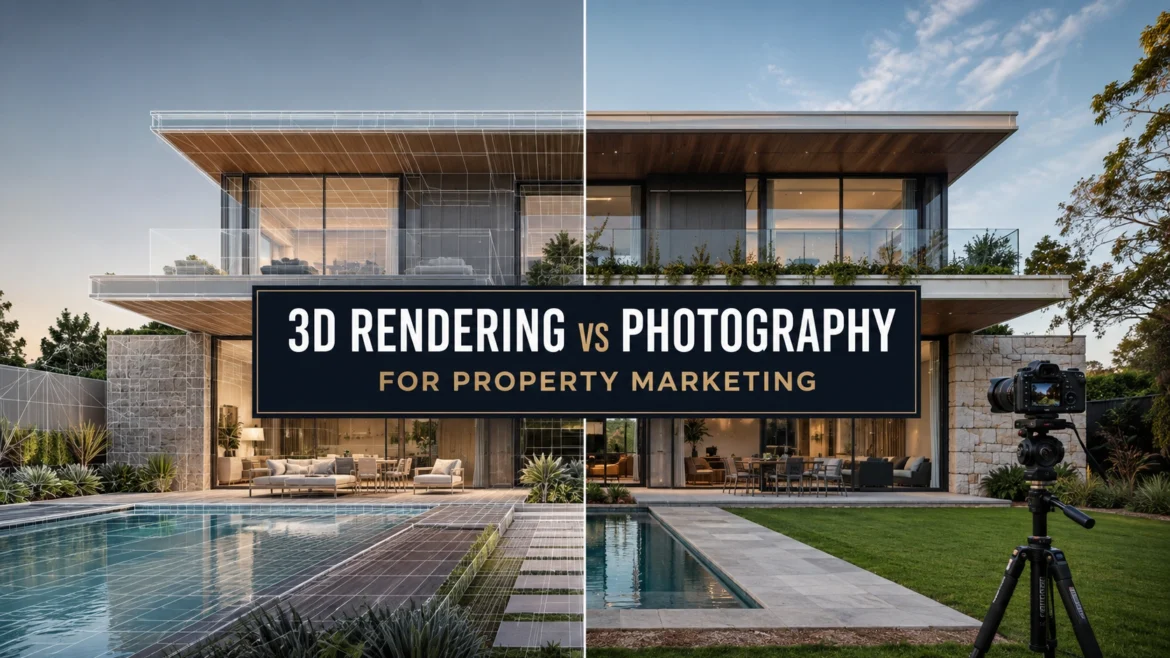
3D Rendering vs Photography: Which Is Better for Property Marketing?
PROPERTY MARKETING · CGI · REAL ESTATE PHOTOGRAPHY
3D Rendering vs Photography: Which Is Better for Property Marketing?
A decision guide for developers, architects and marketing teams choosing between images of an unbuilt proposal, photographs of a completed property or a coordinated transition from one to the other.
- Pre-construction CGI
- Completed-property photos
- Truth and disclosure
- Campaign transition
Quick answer
Should property marketing use 3D rendering or photography?
Use 3D rendering when the property, fitout, landscape or selected design options do not yet exist in a photographable form. Use professional photography when the completed property is accessible, presentation-ready and accurately represents what buyers, tenants or stakeholders will receive.
Rendering provides controlled cameras, lighting, materials, staging and campaign formats before construction is complete. Photography provides direct evidence of the built result, real materials, real context and current condition. Many developments need both at different stages: CGI for presales and approvals, followed by photography after completion. Do not present CGI as a photograph or keep using an outdated render when the built project materially differs.
Plan the visual handoverProject teams we have supported
Who we have worked with






In this guide
Choose from project reality, not habit
Ten factors for choosing 3D rendering or photography
The right medium depends on what physically exists, what the audience must understand and when the campaign needs to launch. Review these factors before building a shot or view list.
-
01
Project stage
Rendering can communicate a proposal before construction or fitout is complete. Photography becomes strongest when the real property is finished and presentation-ready.
-
02
Subject availability
If the building, view, landscape, furniture or finish does not yet exist, photography cannot capture it. CGI can visualise approved or clearly documented intent.
-
03
Design certainty
Rendering needs current drawings and selections. Early images carry more assumption risk; completed-property photography records what was actually built.
-
04
Creative control
CGI offers precise cameras, light, staging, landscape and weather. Photography works within the real site, access, season, orientation and available conditions.
-
05
Built evidence
Photography can demonstrate actual material execution, workmanship, context and current condition. A render communicates design intent rather than proof of completion.
-
06
Site readiness
Photography needs cleaning, styling, landscaping, weather, access and permission. CGI avoids site-day constraints but still needs resolved project information.
-
07
Revision needs
CGI can be revised when documented design decisions change. Photography usually needs another shoot when the physical scene, styling or required angle changes.
-
08
Campaign formats
Plan hero, portal, brochure, signage, social, portrait and mobile crops. Both media need composition and resolution designed around the final placements.
-
09
Timeline and access
Rendering can begin from suitable project files before the site is ready. Photography depends on physical completion, access windows and shoot conditions.
-
10
Disclosure and trust
Label proposed CGI appropriately and avoid presenting it as a photograph. Photography also needs honest editing that does not materially misrepresent the property.
Side-by-side decision guide
3D rendering vs photography: practical comparison
Neither medium is universally better. Compare what can truthfully be shown, the degree of creative control required and whether the campaign represents a proposal or a completed result.
| Decision area | 3D rendering | Photography | Selection rule |
|---|---|---|---|
| What exists | Shows a documented proposal, option or future completed state | Records the real property, finishes, context and condition | Use the medium that matches the project’s actual stage |
| Image control | Precise camera, time, weather, landscape, furniture and material direction | Control through styling, lenses, timing, lighting and post-production within the site | Choose CGI when unavailable conditions are central to the brief |
| Audience meaning | Communicates approved intent and helps explain an unbuilt experience | Provides evidence of the delivered result and current presentation | Disclose CGI; avoid implying that proposed imagery is a photograph |
| Changes | Can be revised from updated project information, within the agreed scope | Physical changes usually require restyling, site access and another shoot | Assess the likelihood of design or presentation changes before production |
| Best campaign stage | Design communication, approvals, investment and off-plan marketing | Completion, leasing, listings, portfolio and built-project documentation | Plan a staged handover when the campaign spans both phases |
For either medium, use the property-marketing render specification guide to align dimensions, ratios, colour requirements and file delivery with the actual channels.
Three useful campaign patterns
When to lead with rendering, photography or both
The campaign pattern should follow the development stage and the truth status of the available subject—not a fixed preference for CGI or photography.
Render-led campaign
Use when sales, approvals or investment communication must begin before the building, fitout, landscape or selected view exists.
- Off-plan marketing
- Controlled design intent
- Multiple campaign crops
- Clear CGI disclosure
Photography-led campaign
Use when the completed property is accessible, styled, clean and representative of the experience the audience can inspect.
- Real finishes and context
- Current condition
- Listings and leasing
- Site-day preparation
Coordinated transition
Begin with clearly identified CGI, then introduce photography after completion while retaining renders only where they explain unavailable views or options.
- Presales continuity
- Planned replacement dates
- Matched crops and hierarchy
- Archive outdated assets
Different stages need different evidence
How does the choice change by project type?
Off-plan residential
Lead with renders for proposed facades, interiors, outlook and amenities; transition to photography when completed residences and shared spaces are genuinely ready.
Visualisation for architectsHouse-and-land and communities
Use CGI for facade options, future streetscapes and landscape maturity; use photography for built display homes, delivered streets and current community facilities.
Rendering for property developersCommercial and mixed use
Use renders for leasing concepts, future tenancy, lobby and precinct activity; use photography to document completed frontage, fitout, access and operational context.
Plan final output specificationsArchitects, builders and portfolios
Use rendering to explain design intent and options; use photography to record the built work. Keep both labelled so proposal and delivered outcome remain distinguishable.
View architectural rendering workPlan from proposal to completion
A six-step rendering-to-photography workflow
- 01
Map campaign milestones
List approvals, investor presentations, presales, construction updates, completion, leasing and portfolio dates that require visual assets.
- 02
Audit what physically exists
Separate approved design information, unfinished construction, completed areas, temporary conditions and photographable built outcomes.
- 03
Assign each view a medium
Choose rendering where the subject is proposed or unavailable, and photography where the real completed scene carries the stronger evidence.
- 04
Coordinate the visual system
Align camera hierarchy, landscape and portrait crops, aspect ratios, naming, colour direction and text-safe areas across both media.
- 05
Define the replacement trigger
Set the completion, access and presentation conditions that allow a photo to replace an earlier CGI asset in each channel.
- 06
Archive and disclose
Remove outdated campaign files, retain approved records and clearly identify CGI or proposed imagery wherever the audience could mistake it for photography.
Combined-visual brief checklist
What should you provide before choosing the medium?
Give the visual team enough information to distinguish proposed content from photographable reality and plan the full campaign lifecycle.
See the project-file checklist- Project stage, campaign milestones and launch deadlines
- Current drawings, model, materials and landscape information
- Completed-area list, site access, styling and shoot constraints
- Named job and truth status for every proposed asset
- Landscape, square, portrait, mobile, print and signage outputs
- Approval owner, disclosure wording and replacement triggers
Completed architectural visualisation work
These are renders—designed to communicate proposed spaces.
The gallery demonstrates the controlled camera, staging, lighting, materials, landscape and context available through 3D rendering. It is not presented as completed-property photography. After construction, a coordinated photography brief could document the delivered result and replace selected campaign assets. Select any image to enlarge it.

Completed project · Wollert, Victoria
936 Kendon Drive exterior rendering
This completed exterior rendering communicates building form, facade rhythm, material contrast, glazing, planting and street relationship in one controlled frame. Its role is to visualise the project—not to claim that the scene is a photograph of the completed building. When suitable site photography becomes available, the team can decide which CGI views still explain unavailable perspectives and which should be replaced by built evidence.
- Medium
- Architectural 3D rendering, created from project information and presented as visualisation.
- Why rendering fits
- The camera, light, facade, planting and streetscape can be coordinated before equivalent completion photography exists.
- Future photo role
- Document actual materials, construction execution, landscape condition and the completed relationship to the street.
- Campaign lesson
- Rendering and photography should form a planned handover, not compete for the same truth claim.
Protect campaign trust
Six mistakes when combining rendering and photography
Presenting CGI as photography
Removing the distinction between proposed imagery and completed-property evidence can mislead audiences and weaken trust.
Photographing before readiness
Unfinished landscape, temporary works, clutter, poor styling or restricted access can permanently lower the usefulness of an expensive shoot day.
Over-editing real photographs
Changing material facts, views, proportions or site conditions can turn documentation into a misleading representation of the property.
Keeping outdated renders live
If approved design or built outcome changes materially, old CGI can conflict with current drawings, photography and sales information.
Duplicating every camera
The same angle in both media is useful only when it supports comparison or continuity. A complementary view may add more campaign information.
Skipping the handover plan
Without replacement triggers, outdated CGI and new photography can circulate together with inconsistent finishes, landscape and project status.
Maintain an approved asset register with the medium, status, date, intended channels and replacement decision for every image. That simple control prevents proposed and completed visuals from being mixed accidentally.
Frequently asked questions
3D rendering vs photography FAQs
Short answers for developers, architects and marketing teams choosing property campaign imagery.
Is 3D rendering or photography better for property marketing?
Neither is universally better. Use 3D rendering to communicate a proposed, unavailable or unbuilt property state. Use photography to document a completed, accessible and presentation-ready property. Many campaigns need both at different stages.
When should developers use 3D rendering instead of photography?
Use rendering when construction, fitout or landscape is incomplete; when approved options need comparison; when a required camera is inaccessible; or when campaign assets must launch before the site is photographable.
When is real estate photography the better choice?
Photography is stronger when the completed property, materials, landscape and context are ready to document and the audience needs evidence of the real delivered result or current condition.
Can 3D renders and photography be used in the same campaign?
Yes. Assign each image a clear job and truth status. Rendering can explain future or unavailable spaces, while photography documents completed areas. Keep labels, finishes and project-stage information consistent.
Are 3D renders more expensive than property photography?
There is no universal answer. Rendering scope depends on model readiness, design detail, views, revisions and output formats. Photography scope depends on location, access, preparation, styling, crew, licensing, retouching and reshoots. Compare like-for-like deliverables.
How should CGI property images be labelled?
Use clear wording appropriate to the context, such as architectural visualisation, artist impression, CGI or proposed imagery. Do not allow an audience to reasonably mistake an unbuilt proposal for completed-property photography.
Should photography replace architectural renders after completion?
Replace renders where photography provides a more accurate current representation. Retain clearly labelled CGI where it still explains an unavailable viewpoint, future stage, option or intended condition that photography cannot show.
What information is needed to plan the right visual approach?
Provide the project stage, drawings, model, material and landscape information, completed-area status, site access, campaign dates, required views, output ratios, disclosure requirements, approval owner and planned replacement triggers.
Request a visual campaign recommendation
Does your next campaign need rendering, photography or a staged mix?
Share the project stage, drawings, completed-area status, site access, audience, campaign channels and deadline. 3D Space Design can define the render views, formats, crops and handover plan needed before photography becomes the stronger medium.
- Quote response within 24 hours
- Up to three revision cycles within the agreed scope
- NDA and confidential-project support
- Defined asset jobs, truth status, outputs and handover triggers
PROJECT ENQUIRY
Tell us what exists—and what must be shown
Include the project type, stage, required views, completed areas, placements, audience, deadline and available drawing or model files.